
November 24, 2026
The Difference Between Brand Lift and Business Outcomes
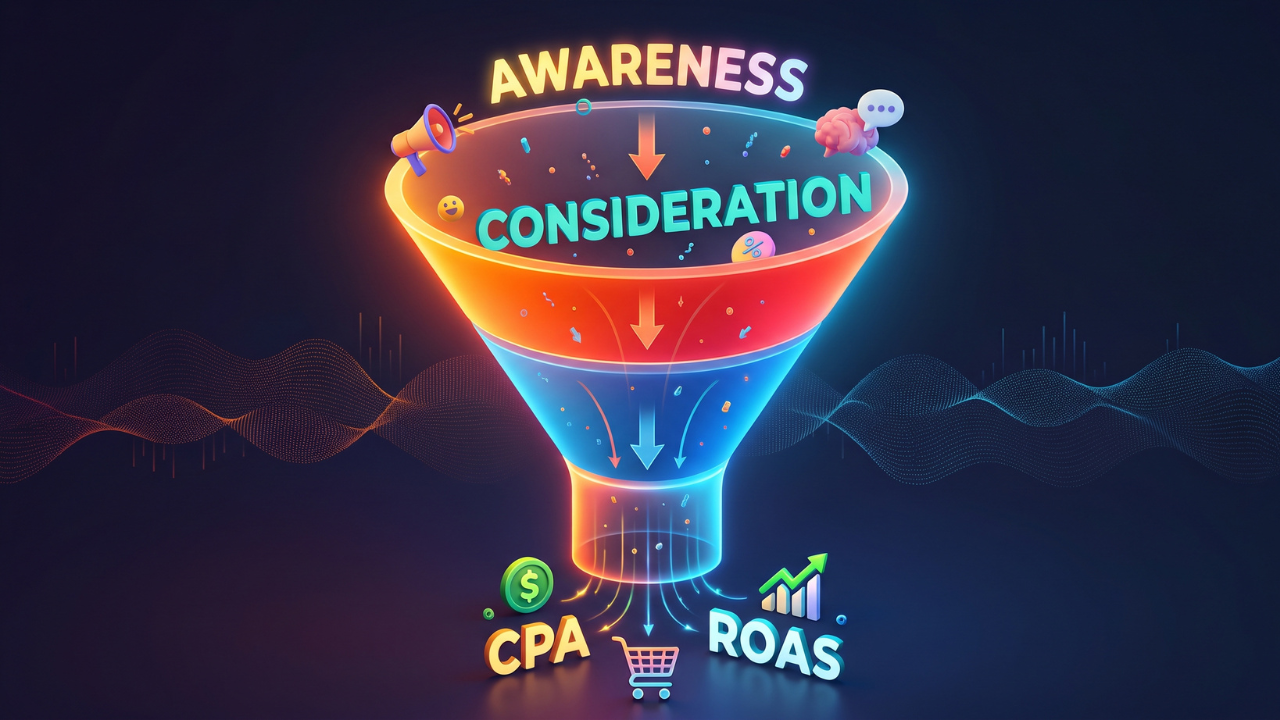
A campaign can move brand awareness by double digits and still fail to move a single sale. It can also drive a spike in orders without shifting how anyone feels about the brand at all. Both are real results. Neither tells the whole story on its own.
The confusion starts because brand lift and sales both get called “proof it worked.” They’re not measuring the same thing, and treating them interchangeably leads to two common mistakes: killing an awareness campaign because it didn’t show up in CPA, or scaling a response campaign because it “felt” like it was building the brand when nothing was actually tracked.
What Brand Lift Actually Measures
Brand lift isolates whether advertising changed how people think and feel about a brand, not whether they bought anything. It’s measured through matched exposed-versus-unexposed survey panels, comparing responses on awareness, ad recall, consideration, favorability, and purchase intent between the two groups.
The methodology matters as much as the metric. A brand lift study without a genuine control group isn’t measuring lift, it’s measuring general sentiment among people who happened to see an ad, which can be skewed by everything from seasonality to unrelated press coverage. A properly matched study isolates the campaign’s actual contribution, typically reported with statistical confidence around 95%.
This is genuinely useful information. It tells you whether the creative is landing, whether the message is memorable, and whether repeated exposure is building the kind of recognition that shortens the path to purchase later. What it doesn’t tell you is whether any of that translated into revenue this quarter.
What Business Outcomes Actually Measure
Business outcomes are the transactional side: orders, leads, revenue, CPA, ROAS. These get measured through response tracking, conversion attribution, and increasingly, incrementality testing that isolates what the campaign actually caused versus what would have happened anyway.
Incrementality and brand lift share a research design, exposed households against a matched control, but they answer different questions. Incrementality testing asks whether the campaign drove incremental purchases. Brand lift asks whether it changed perception. Running only one leaves a real gap: a campaign optimized purely for incrementality can win on CPA while quietly eroding brand equity through overexposure or off-message creative, and a campaign optimized purely for brand lift can build glowing sentiment that never converts into a customer.
Why TV Has to Deliver Brand Lift and Sales at Once
Television, more than almost any other channel, is asked to do both jobs at once. Linear delivers broad reach efficiently, which makes it a natural brand-building vehicle. CTV adds the targeting and attribution precision that makes performance measurement possible. A converged strategy runs both simultaneously, which means the measurement plan has to account for both outcomes rather than defaulting to whichever one is easier to report.
This is where DRTV’s reputation as “the measurable channel” can mislead. Response tracking answers the business-outcomes question well. It says nothing about whether the same campaign is building brand equity, and a brand-lift study is a separate, deliberate measurement effort layered on top, not something response data produces as a byproduct.
When to Measure Brand Lift vs. Business Outcomes
The practical fix isn’t choosing one metric over the other. It’s deciding upfront which question a given campaign is meant to answer, and measuring accordingly.
An upper-funnel campaign built around a category launch or a new market entry should be evaluated primarily on brand lift: awareness gains, recall, and shifts in consideration among a previously unfamiliar audience. Holding that campaign to a CPA target it was never designed to hit produces a false negative.
A bottom-funnel, offer-driven campaign built around a specific promotion should be evaluated primarily on incrementality and CPA. Layering a brand lift study onto a two-week promotional flight rarely produces a statistically meaningful read, since the sample and timeframe are usually too thin for the panel methodology to separate signal from noise.
Most converged TV programs sit somewhere between these two poles, which is why a growing number of measurement programs run both: incrementality testing to validate the performance side of the buy, brand lift studies at intervals to confirm the campaign isn’t winning on efficiency while losing on brand health.
Connecting Both Signals to One View
Isolated, brand lift and business-outcome metrics tell partial stories. Connected, they tell you something more useful: whether the campaign is building an asset that makes future performance cheaper, or just renting attention one flight at a time.
This is the reasoning behind pairing linear’s reach with CTV’s precision in a single converged buy rather than running separate brand and performance campaigns through separate channels. A unified measurement layer, like Rainstorm Direct’s Tracker™ platform, is what makes it possible to see both signals against the same media plan instead of reconciling two disconnected reports produced by two different teams.
One Campaign, Two Questions
Brand lift and business outcomes aren’t competing metrics. They’re answers to two different questions a single campaign can be asked to answer at once: did this change how people feel about the brand, and did it make them buy.
The programs that get this right don’t pick a favorite. They decide which question matters for a given flight, measure it properly, and check the other one often enough to know when short-term efficiency is quietly costing something bigger.
Frequently Asked Questions
Can brand lift and CPA both improve from the same campaign?
Yes, and it’s the sign of a well-built converged strategy. Strong creative delivered at an efficient frequency can build recall while also driving response, particularly when linear establishes awareness and CTV retargets exposed households who haven’t converted yet.
How long does a brand lift study need to run?
Enough exposure and response volume to reach statistical confidence in the exposed-versus-control comparison, generally requiring a sustained flight rather than a short promotional burst. Timelines vary by audience size and campaign scale.
Should every campaign include a brand lift study?
No. Short, offer-driven flights rarely generate enough sample to produce a reliable read. Brand lift is best reserved for sustained awareness campaigns or periodic checks across an always-on program, not every individual promotion.
What’s the risk of only measuring business outcomes?
A campaign can look highly efficient on CPA while quietly depleting brand equity through overexposure, message fatigue, or creative that converts short-term but damages long-term favorability. Business outcomes alone won’t surface that until it shows up as rising CPA months later.
Stay up to date with Rainstorm Direct insights
Thank you!
Someone from Rainstorm Direct will contact you shortly.